
In New Zealand, a standard pergola warranty typically ranges from 10 to 15 years for the structural aluminium frame and powder coating, while motors and electronics usually carry a 3 to 5-year warranty. Crucially, these manufacturer warranties sit alongside the statutory protections provided by the Consumer Guarantees Act 1993, which requires goods to be of acceptable quality and last for a reasonable time.
Standard Warranty Periods: What to Expect in NZ
When investing in a high-quality outdoor structure in New Zealand, understanding the warranty landscape is critical. A warranty is not merely a piece of paper; it is a manufacturer’s pledge regarding the longevity and durability of their product against the unique, often harsh, New Zealand climate. The market standard for premium aluminium pergolas has settled into a specific rhythm, but variations exist depending on the supplier and the materials used.
Generally, New Zealand consumers should expect a tiered warranty structure. Unlike a single blanket policy covering the entire unit, reputable suppliers break down their coverage into specific components. This is industry standard practice because different materials degrade at different rates. For instance, the structural integrity of extruded aluminium far outlasts the operational lifespan of an electric motor.
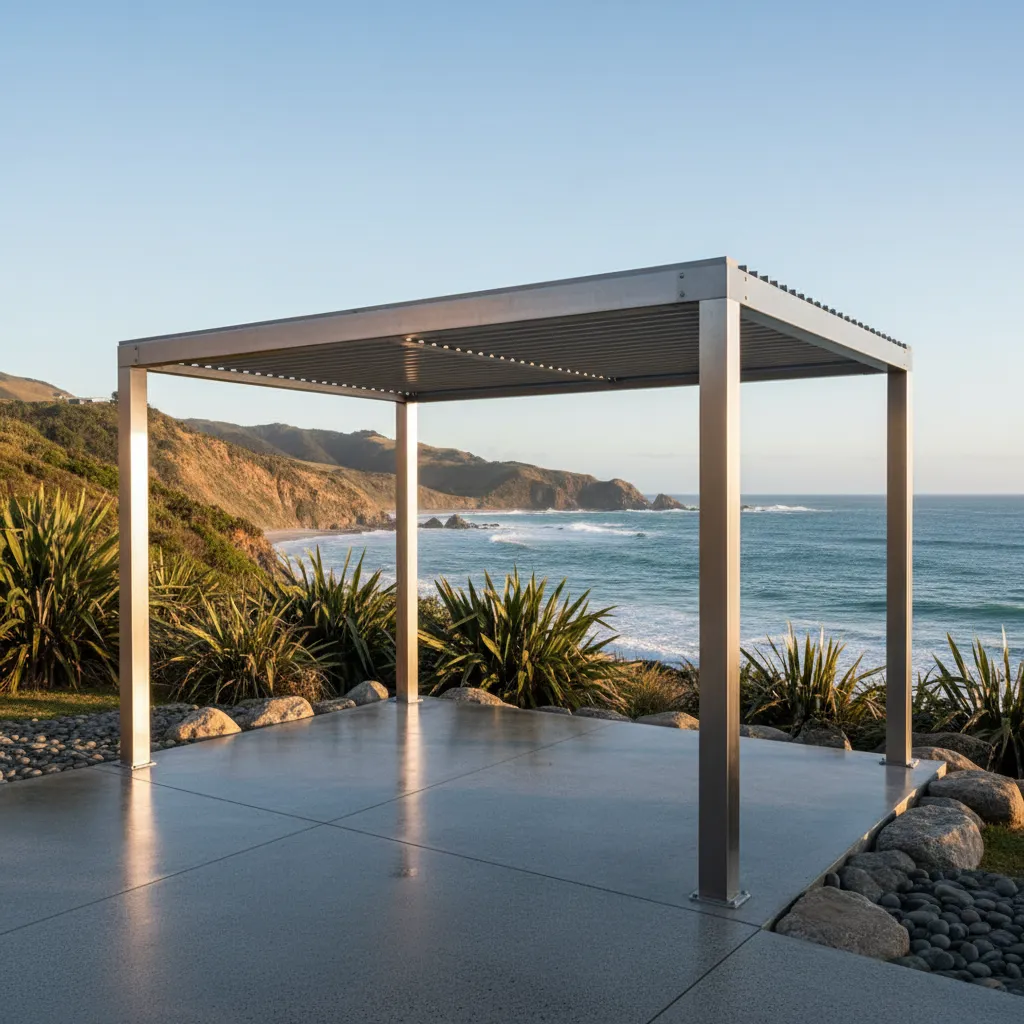
Component Breakdown: Powder Coat vs. Motors
To truly evaluate the value of a quote, you must scrutinize the fine print regarding specific components. Here is a detailed breakdown of what constitutes a “good” warranty in the current NZ market.
1. Structural Frame (Aluminium)
Standard: 10–25 Years
The skeleton of your pergola, usually made from high-grade T6063 aluminium, should carry the longest warranty. This covers the metal against structural failure, significant sagging, or corrosion that impacts integrity. In New Zealand, a 10-year structural warranty is the minimum acceptable benchmark, with premium European or top-tier local brands offering up to 25 years.
2. Powder Coating (Surface Finish)
Standard: 7–15 Years
This is where warranties get complex. The warranty on the paint finish (powder coat) is often dictated by the powder manufacturer (e.g., Dulux or Interpon) rather than the pergola company. The duration depends heavily on the “Durability Class” of the powder used:
- Standard Durability: Typically 7–10 years. Suitable for most inland residential areas.
- Super Durable (Marine Grade): Typically 15+ years. Essential for coastal zones.
It is vital to note that powder coat warranties almost always include a clause regarding “film integrity” (the paint not peeling) versus “color retention” (fading). Some fading over a decade is considered normal wear and tear and is not covered.
3. Motors and Electronics
Standard: 3–5 Years
Automated louvre roofs rely on linear actuators and control boxes. Brands like Somfy or reputable linak actuators generally come with a 5-year warranty. If a supplier offers only 1 or 2 years on the motor, it is a red flag suggesting the use of lower-quality generic components. This warranty covers mechanical failure but usually excludes damage caused by power surges—surges which are common in some semi-rural NZ areas.
4. Rain Sensors and LED Lighting
Standard: 2–3 Years
Peripherals are the most fragile components. LED strips and rain sensors differ vastly in quality. A 3-year warranty is excellent for lighting, while 2 years is standard.
The Consumer Guarantees Act (CGA): Your Secret Weapon
In New Zealand, your protection extends far beyond the written warranty card provided by the installer. The Consumer Guarantees Act 1993 (CGA) acts as a statutory safety net that cannot be contracted out of for residential purchases.
How does the CGA override written warranties?
Even if a pergola manufacturer’s warranty has expired (e.g., the motor fails in year 6 of a 5-year warranty), you may still have grounds for a claim. The CGA requires that goods must be of “acceptable quality.” This means the product must be:
- Fit for all the purposes for which goods of the type are commonly supplied.
- Acceptable in appearance and finish.
- Free from minor defects.
- Safe.
- Durable.
The definition of “durable” is the key. A reasonable consumer would expect a $20,000 automated pergola system to last longer than 5 years without major mechanical failure. If a motor fails prematurely, you can argue under the CGA that the product was not reasonably durable, regardless of the written warranty expiration.

The “Fit for Purpose” Clause
If you told the supplier you live in a “Very High” wind zone (e.g., Wellington hilltops) and they installed a standard pergola that subsequently buckled in a storm, they are liable. Under the CGA, if you rely on the supplier’s expertise and the product fails to meet the specific purpose you discussed, the supplier must remedy the issue, replace the unit, or provide a refund.
Adding a Pergola to House Insurance
A common mistake New Zealand homeowners make is assuming their existing house insurance automatically covers a new pergola. While policies differ, a pergola is generally considered a “permanent structure” or “retaining wall/landscape structure,” but it increases the replacement value of your home.
Do I need to notify my insurer?
Yes, immediately. When you install a pergola, you are increasing the “Sum Insured” of your property. If your house is insured for $600,000 and you add a $30,000 pergola, your rebuilding cost is now $630,000. If you fail to update your policy and your home is destroyed by fire or earthquake, the payout may be capped at the old limit, leaving you out of pocket for the pergola.
Contract Works Insurance
During the installation phase, standard house insurance often excludes liability for the area under renovation. If the pergola costs more than a certain threshold (often $25,000, though this varies by policy), you may need Contract Works Insurance. This covers damage to the works (the pergola) and the existing structure during the build process.
What Voids a Pergola Warranty?
Warranties are two-way agreements. While the manufacturer guarantees quality, the owner guarantees proper use. In the context of New Zealand’s specific environmental challenges, several actions—or inactions—can instantly void your coverage.
1. DIY Installation
Many high-end pergola brands (such as those using motorized louvres) explicitly void warranties if the product is not installed by a certified dealer. The alignment of the frame and the calibration of the motors are precise; amateur installation often leads to torque issues that burn out motors or cause leaks.
2. Neglecting Coastal Maintenance
This is the most common reason for declined claims in NZ. If you live within 5km of the coast (which is most of New Zealand), salt spray is a constant threat. Warranties for powder coating usually mandate a cleaning schedule (e.g., washing the frame with warm soapy water every 3 to 6 months). If corrosion appears and you cannot prove you adhered to this maintenance schedule, the warranty is null and void.
3. Modification and Attachments
Drilling into the legs to mount a heater, hanging a heavy swing chair from a louvre, or attaching blinds that were not factory-approved can compromise the structural integrity. Once the aluminium skin is pierced by a non-authorized screw, the corrosion resistance is compromised, and the manufacturer is no longer liable for the result.
4. Exceeding Wind Zones
Pergolas are engineered to specific wind ratings (Low, Medium, High, Very High, or Extra High). If a standard pergola is installed in an Extra High wind zone and is damaged by a gale, the warranty will not cover it. It is the responsibility of the purchaser (and installer) to ensure the engineering specs match the local wind zone data.
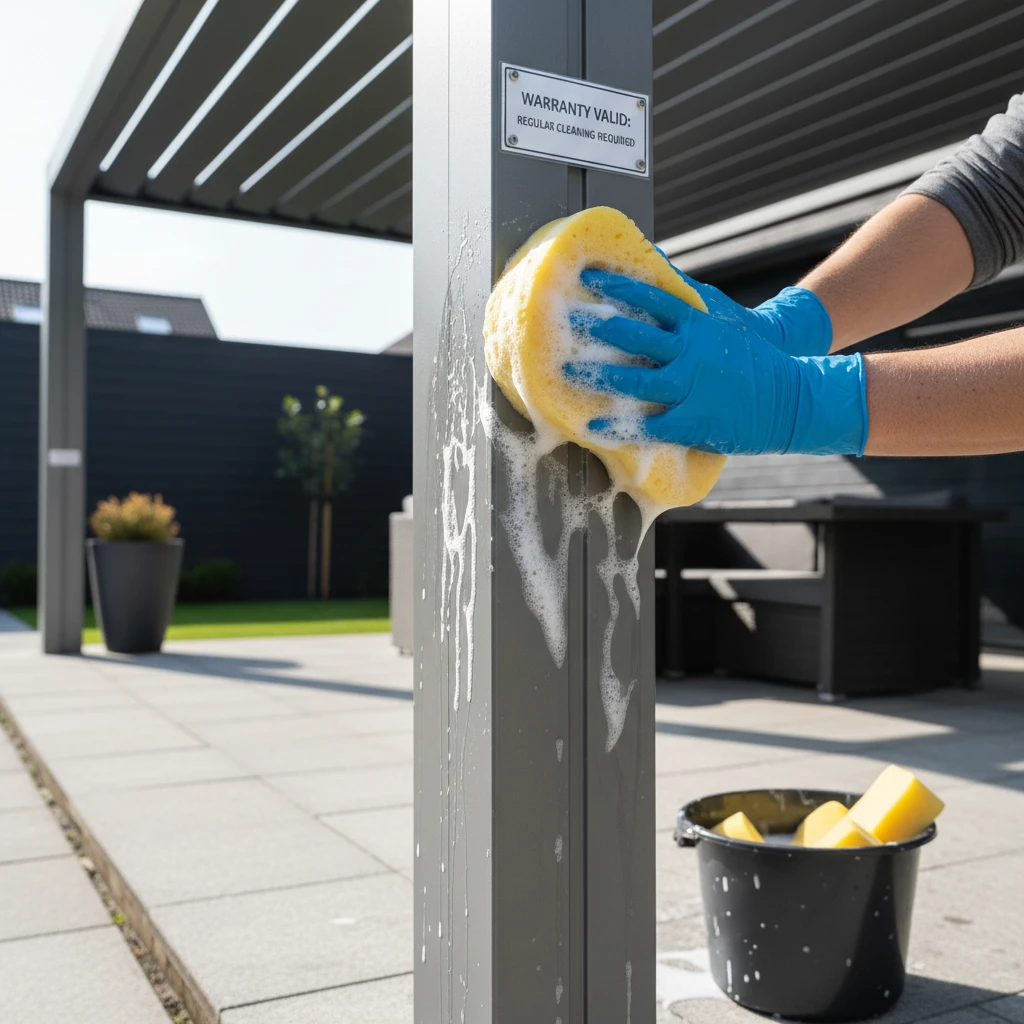
Mandatory Maintenance for Warranty Validity
To keep your warranty ironclad, you should maintain a “maintenance log.” This might sound excessive, but for a high-value asset, it is prudent.
- The Wash Down: Every 6 months (or 3 months in coastal zones), wash the aluminium with a soft brush and mild detergent. Never use solvent-based cleaners.
- Gutter Clearing: Internal gutter systems in louvre roofs must be kept free of leaves. Blocked gutters can cause water to back up into the motor housing, causing failure that is considered “negligence” rather than a product defect.
- Visual Inspection: Check silicon sealants annually. Silicon degrades over time due to UV exposure. Re-sealing is a maintenance task, not a warranty claim.
By adhering to these guidelines, you ensure that if a defect does arise, the manufacturer has no grounds to deny your claim.
Frequently Asked Questions
Does DIY installation void the warranty on a pergola kitset?
For most premium motorized systems, yes, DIY installation voids the warranty. However, for specific “kitset” products sold explicitly for DIY, the warranty remains valid provided you followed the assembly instructions exactly. Always check the terms and conditions before purchasing.
Are pergola motors covered by house insurance?
Generally, yes, if the damage is caused by an insured event like a lightning strike, fire, or power surge (fusion). However, insurance does not cover “wear and tear” or mechanical breakdown due to age. You may need a specific fusion benefit in your policy.
How long is a standard powder coat warranty in NZ?
Standard durability powder coating typically has a 7 to 10-year warranty. High-grade “Super Durable” or marine-grade finishes can carry a warranty of 15 to 20 years, which is recommended for New Zealand coastal properties.
Does the Consumer Guarantees Act apply to custom pergolas?
Yes. The CGA applies to all goods and services sold for personal, domestic, or household use. A custom-designed pergola falls under this category, meaning it must be fit for purpose and finished with reasonable care and skill.
What happens if the pergola company goes out of business?
If the installer goes under, your workmanship warranty is likely gone. However, the product warranties (for the motor, the aluminium, the powder coat) often rest with the parent manufacturer or importer. You may be able to claim directly against the manufacturer of the components.
Is storm damage covered by the manufacturer warranty?
No. Manufacturer warranties cover defects in materials and workmanship. Damage caused by “Acts of God,” such as storms, earthquakes, or falling trees, is a matter for your house insurance, not the product warranty.